
Quickplay has launched Live Operations, an AI-powered broadcast control platform for live broadcast and OTT channels. The cloud-native solution centralizes critical operational workflows through a single management console.
With AI-driven broadcast control, it is possible to schedule, signal, decide on advertisements, create clips, and monitor everything. This system also delivers AI-driven intelligence for live broadcasts and editorial work. Quickplay will be demonstrating Live Operations at IBC 2026 in Hall 5.G86. The platform targets broadcasters, streaming operators, news providers, sports rights owners, and multi-channel operators.
“Many broadcasters today use AI to do smart things in metadata, in packaging, in ad decisioning, each creating individual value, yet completely disconnected from the others. With live programming, the time needed to connect these dots is time operators simply don’t have. Viewers will have moved on, as will the revenue,” said Paul Pastor, Co-Founder and Chief Business Officer, Quickplay. “AI at a single step creates value. But AI orchestrated across every step, across an entire broadcast network, creates compounding value. At IBC, we’re showcasing the power of this live AI workflow and highlighting the success Television New Zealand (TVNZ) and Gray Media are seeing with it.”
Moreover, Live Operations supports distributed sites without requiring full-time engineers at every location. It also manages regional blackouts and multiple channels simultaneously.
Quickplay Simplifies Live Broadcast Operations
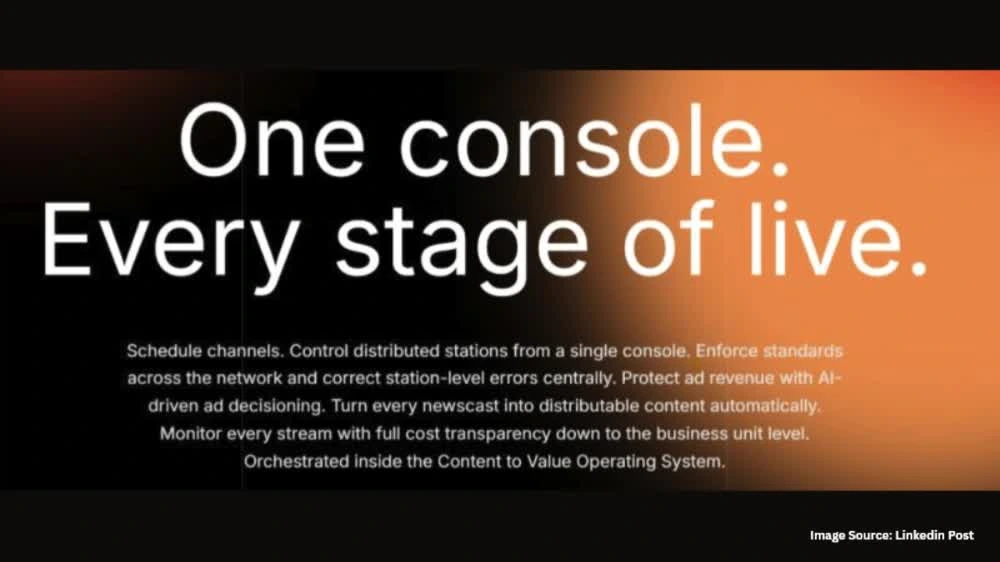
Many broadcasters today use separate tools for scheduling, signaling, advertisements, and clipping. The delay in resolving technical problems is usually experienced due to this. This is where Quickplay seeks to reduce complexity by using orchestration and real-time operations monitoring. The company reported that broadcasters use about 75% of their time to manage technical workflow. Live Operations provides centralized tools for managing schedulers, EPGs, live signals, ad breaks, SCTE-35 markers, and real-time metadata.
Schedule conflicts are automatically detected by the platform before the broadcasts take place. While that happens, the operator has full control of the switcher, slating, fallbacks, and channel activities through a single dashboard. The disruption and fallback features in the platform help to safeguard the broadcast process in case of a signal failure.
Moreover, the Live-to-VOD and Clip Factory platforms employ AI for the conversion of broadcast videos into short-format video content that comes with revamped metadata and vertical video formats.
“Live has no margin for error,” said Juan Martin, Co-Founder and Chief Technology Officer, Quickplay. “Live Operations challenges today’s status quo by eliminating the need for disconnected systems so that if something breaks down during a live broadcast, teams are notified and a fix is in process in real-time. No dead air, no missed SCTE cues, no failed signals. This is AI doing what it should do, backed by the assurance of a Content to Value Operating System purpose-built to support transformation.”
Live Operations works within the Content to Value Operating System of Quickplay and its Stream engine. Consequently, the platform links live operations with overall media production and monetization features. With the use of artificial intelligence-based broadcasting controls, Quickplay seeks to provide more orchestration, efficiency, and reliability in broadcast networks.
Want more marketing excellence stories? Visit MarTech News for insights, trends, and expert updates.
News Source: PRNewswire.com