
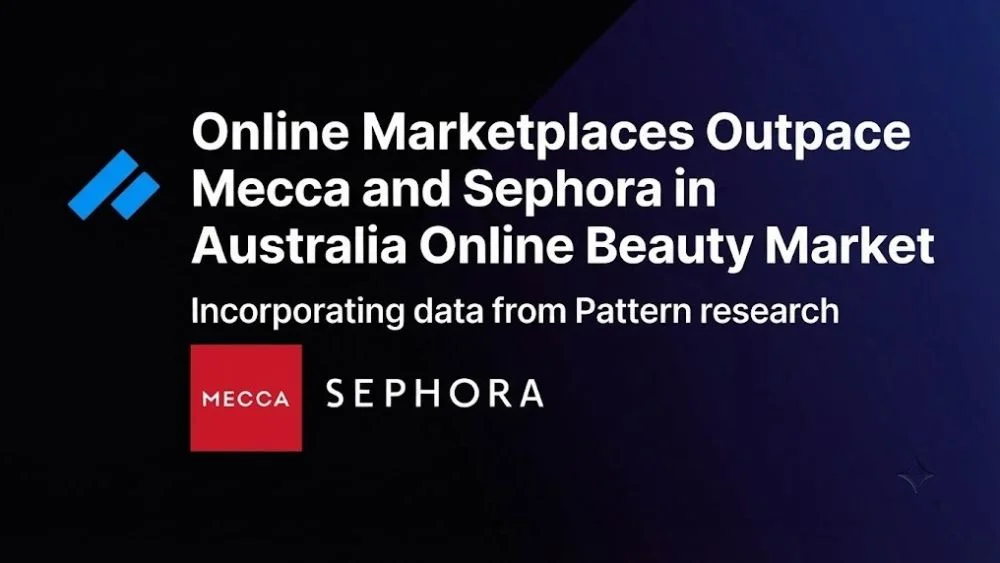
Australia Online Beauty Market now earns as much as Australia’s major specialist beauty retailers combined. Global ecommerce accelerator Pattern revealed this in a new report on the Australia online beauty market. The findings point to a major shake-up in beauty retail.
The 2026 State of Beauty & Personal Care in Australian Ecommerce report offers a bold forecast. Pattern expects the Australia online beauty market to grow 47% to the US. 200 million in online beauty sales in Q4 2025. Meanwhile, specialist beauty and health retailers, including Mecca, Sephora, Adore Beauty and Chemist Warehouse, collectively reported A$199.3 million.
“Australia’s beauty market is growing rapidly, but the balance of power is shifting. Marketplaces are now competing directly with the country’s established beauty retailers, while consumers are becoming less tied to traditional shopping channels and even their favourite brands,” said Merline McGregor, Managing Director for Pattern Australia. “While there is significant opportunity for beauty brands, there is also the risk of losing customers to competitors that are easier to discover and purchase online.”
Influencers Reshape Beauty Product Discovery and Purchasing
Social media is changing the beauty shopping journey across Australia. Nearly half of beauty buyers (47%) are more likely to buy after a creator recommendation. By comparison, only 15% of non-beauty buyers react the same way.
Instagram and Facebook each influenced 47% of beauty buyers to consider or buy products last year. YouTube followed at 45%, while TikTok reached 38%. However, discovery on social media does not always lead to a sale on the same platform. Among buyers who find a product on social media, 39% would most likely buy directly from a retailer or brand website. Another 32% would head to Amazon instead.
“Beauty has become one of the most socially influenced retail categories, as consumers discover products through creators, watching demonstrations and researching ingredients long before deciding where to buy,” said McGregor. “But discovery and purchasing are increasingly happening in different places. A consumer might discover a skincare product on TikTok, research it on Google and then purchase it from Amazon. Brands need to connect these channels to turn consumer interest into sales.”
Amazon Challenges Beauty Brand Loyalty
Amazon recorded a A$66.7 million year-on-year rise in Australian beauty and personal care sales in Q4 2025. As a result, the marketplace now holds 19.9% of the Australia online beauty market.
The research also shows strong buying intent. Specifically, 71% of Australian online beauty buyers plan to shop on Amazon within the next 12 months. Yet the findings also expose a threat to brand loyalty. Indeed, 43% of consumers would consider a similar product from a rival brand if their first choice is not on Amazon.
“Brand loyalty has traditionally been a major strength of the beauty industry, but convenience and availability are increasingly influencing purchasing decisions. When more than four in 10 beauty buyers are prepared to switch brands because they can’t find their preferred product on Amazon, that’s a significant commercial risk,” explained McGregor. “Consumers aren’t thinking about a brand’s distribution strategy. They simply expect beauty products to be available through the channels they use, and they’re willing to switch brands for that convenience.”
AI Accelerates the Shift in Beauty Shopping
AI is also changing how Australians shop for beauty. Compared with last year, 38% of beauty buyers now lean more on AI tools to find products online. Additionally, more than a quarter (27%) have used ChatGPT or a similar AI assistant to research or buy products. Notably, 55% trust AI-generated product recommendations.
“AI, social media and marketplaces are changing how consumers find, research and purchase beauty products. As online beauty sales surge in Australia over the next few years, the brands that grow will be those that understand how shopper behaviour is evolving across multiple touchpoints,” added McGregor.
“A great product can only go so far if consumers can’t discover it, find credible information about it or purchase it through their preferred channels. Brands need to make themselves visible and available at every stage of the shopping journey to grow their share of Australia’s beauty market,” McGregor concluded.
Want more marketing excellence stories? Visit MarTech News for insights, trends, and expert updates.
News Source: PRNewswire.com