
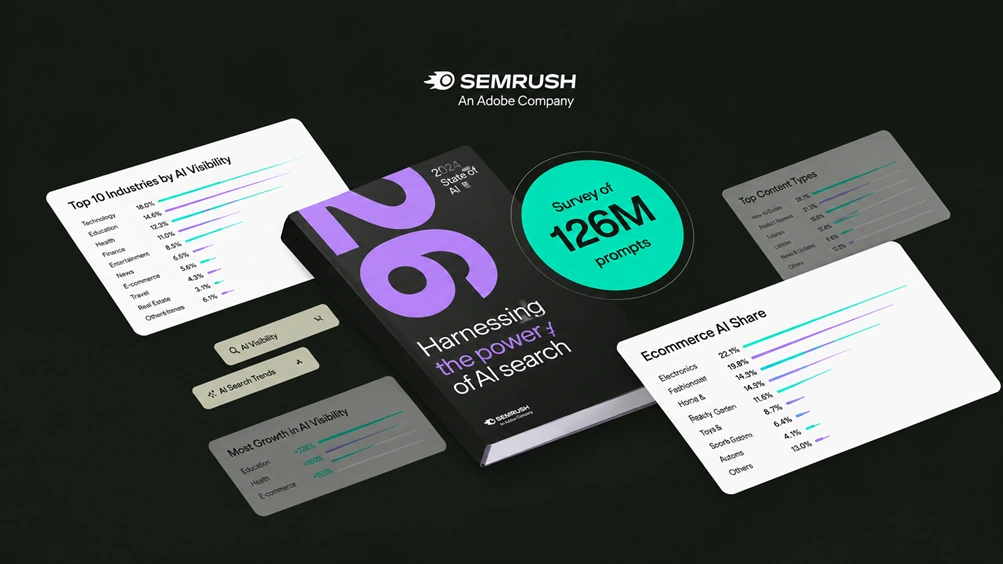
Semrush has released an enhanced AI Visibility Index, which is said to be one of the most comprehensive studies on AI-powered search behavior. The AI Visibility Index examines 126 million AI search prompts in the U.S. from January to April 2026. The report helps brands understand how they’re referenced, cited and represented by AI platforms across digital discovery channels.
The new index is a significant expansion of the original index, which was published in September 2025. Semrush is now tracking millions of AI-generated searches instead of 2,500 prompts. That gives marketers a more granular view of how search behavior and brand visibility is shifting across a variety of industries.
AI-driven traffic is still accelerating, according to Adobe data. AI referrals to retail sites in the U.S. grew 1,324% from October 2024 to May 2026. Likewise, AI traffic in the travel industry climbed 2,215% during the same period. However, many organizations still struggle to measure their visibility across AI-generated responses. Semrush found that 45% of marketing leaders cannot accurately measure AI brand visibility, while only 9% track every relevant metric.
“Your AI narrative is becoming the decisive entry point to your customer experience,” said Rachel Thornton, CMO, Adobe Enterprise. “But the new reality is, your customers are both people and AI agents. Minimizing brand drift to ensure accuracy and consistency across every digital touchpoint is now the starting point for securing visibility. This requires new content strategies, stronger data foundations, and organization-wide governance.”
Study Highlights How AI Search Is Reshaping Brand Visibility
The AI Visibility Index establishes performance benchmarks across 22 industries. It also explains why brands perform differently across ChatGPT, Gemini, Google AI Mode, and Google AI Overviews. Different platforms have different citation patterns and content sources and opportunities for brand discovery vary.
The report explains that AI platforms now rely on owned websites, publisher content, community discussions, retailers, and reference platforms when generating answers. Consequently, brands must focus on both visibility and credibility instead of traditional search rankings alone.
“AI is now intrinsic to the default search experience, and brands need to adapt. The name of the game is Brand Visibility,” said Andrew Warden, Vice President of Marketing at Adobe and former CMO of Semrush. “The foundations of SEO are critically important in creating trust signals for AI, but visibility now depends on how consistently a brand reinforces its narrative across digital channels. Marketing teams need to redesign how they work across SEO, content, communications, data, and brand governance to compete in this new environment.”
The report also found that brand mentions and citations represent different measures of AI visibility. Additionally, visibility varies widely across industries. Only 36 global brands maintained top-100 visibility across every AI platform during the study period. Furthermore, organizations that integrated SEO with AI visibility strategies reported stronger business outcomes than companies managing both areas separately.
Want more marketing excellence stories? Visit MarTech News for insights, trends, and expert updates.
News Source: Businesswire.com