
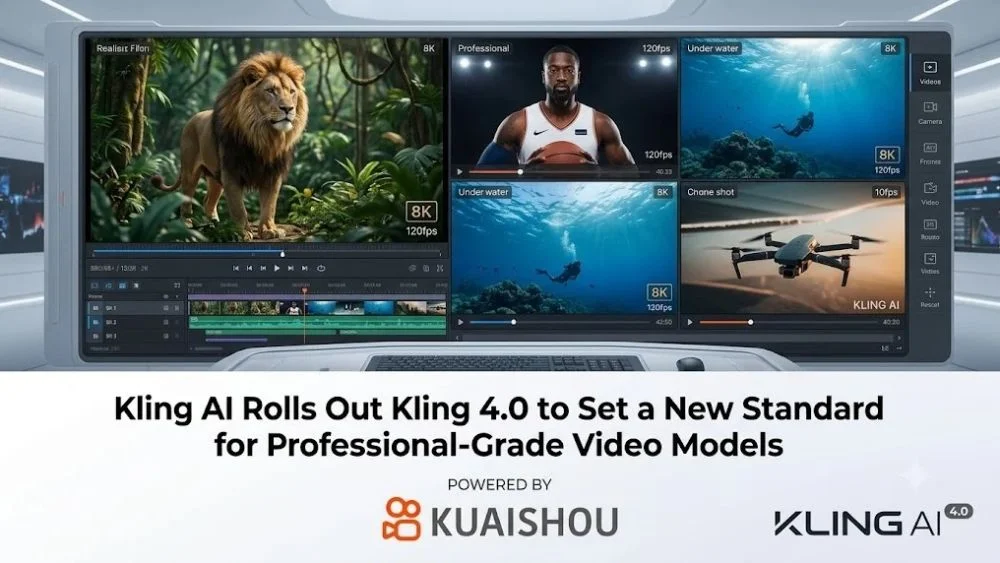
Kuaishou Technology made a major announcement today. Kuaishou is a leading content community and social platform. Its Kling AI team officially launched Kling 4.0, a new-generation AI video generation model, on October 15.
Kling 4.0 focuses on three priorities: realism, control, and professional quality. The model targets video scenes with intense motion and complex camera movements. As a result, it delivers breakthroughs in three areas. First, it offers steadier large-scale motion, with smoother continuity in high-speed action and complex camera work. Second, it generates up to 30 seconds natively in a single pass. This supports long takes and continuous storytelling with a director’s mindset throughout. Third, Omni Reference accepts up to 15 reference assets and up to 10 keyframe inputs. Consequently, creators can turn a single idea into a complete work.
Kling AI continues to work closely with professional creators to bring their projects to completion. Delivering high-quality key shots remains a central focus as the Kling model evolves. Professional creators need more than the occasional stunning shot. They must reliably deliver the key shots that define the quality of their work. They also need to bring generated footage into a complete production workflow. Kling AI believes the value of technology goes beyond generating content. It also makes the care behind every frame visible. Every emotionally charged close-up deserves to be done justice. Likewise, every key shot that defines the look and feel of an entire work does too.
Steadier Dynamic Motion and Complex Camera Work Power Kling 4.0
Kling AI has long been known for film-grade dramatic scenes. Its characters show nuanced, lifelike emotions. Building on this strength, Kling 4.0 tackles one of the most common pain points in AI video. It delivers more stable and fluid large-scale dynamic motion and complex camera movements. Whether the shot involves high-speed action or sweeping tracking and orbit moves, the model maintains stable visuals and continuity. Thus, AI video generation moves closer to true production-grade delivery.
On the audiovisual front, Kling 4.0 supports output of up to 10-bit HDR. This brings richer color depth and smoother transitions between light and shadow. In high-contrast scenes such as backlit shots, night scenes, and neon-lit settings, it preserves more detail in highlights and shadows. Therefore, colorists gain more room for grading in post-production. Kling 4.0 will also support 4K, 1080p, and the 21:9 ultrawide format. These capabilities expand the field of view and compositional possibilities. For creators who refine their work carefully, they are more than spec upgrades. They form the foundation for a higher level of polish and a more distinctive aesthetic.
The model also improves camera direction. Its understanding of push-ins, pull-outs, pans, trucking shots, tracking shots, and orbit shots has grown stronger. Changes in shot size and transitions now feel smoother and more natural. Moreover, the model expands and enriches prompts with a director’s eye. Prompt input length now reaches 8,000 tokens, so creators can convey intent more fully and precisely.
Flexible Omni Reference Offers 15 Reference Assets, 10 Keyframes, and Video Extension of up to Two Minutes
If 2025 marked the breakout year for AI video generation, 2026 has seen the industry boom. Competition has also shifted. The question is no longer whether AI can generate video at all. Instead, it is whether AI can do so reliably and with precise control.
The upgraded Omni Reference combines images, videos, subjects, and voices in a single task. It supports up to 15 references in total, including up to 10 images, 5 videos, and 7 subjects. These inputs work together to keep characters, actions, shots, and audio closer to the intended results. Kling 4.0 accepts subject images, three-view character sheets, grid images, storyboards, and wireframes. Furthermore, creators can use video inputs to reference character performance, action, camera movement, and narrative pacing. White-model videos and depth-map videos also work as references.
Creative recreation gets an upgrade as well. Creators can draw on a reference video’s narrative pacing, shot composition, and expressive style. Then they can replace the products, characters, and assets inside it. This quickly turns proven creative ideas into original content. Similarly, it speeds up commercial videos for product advertising, viral social media content, fashion and beauty, and consumer electronics.
Precise multi-keyframe control lets creators set up to 10 key visual moments. They can specify character states, scene changes, and story beats, so content progresses naturally in the intended direction. Meanwhile, the video extension feature will soon support multiple extensions of up to two minutes. This gives actions, emotional build-up, and multi-part storylines more room to unfold.
Kling 4.0 Powers Professional Content Creation and Takes Great Stories Global
AI is profoundly transforming production workflows in film, television, and advertising. As generative capabilities improve, the value of AI video tools is shifting from boosting efficiency to enabling professional expression. These tools increase content production capacity. They also help creators consistently bring shots with higher aesthetic standards to life.
Kling 4.0 is expanding into more creative use cases and genres, including film and television, short dramas, animation, and advertising. At this summer’s Cannes Lions International Festival of Creativity, two works created with Kling AI won Gold Lions. The festival incorporated AI into its judging framework for the first time. Clearly, AI-generated visuals now play an increasingly central role in advertising storytelling.
Additionally, Kling 4.0 now integrates with Kling MCP and CLI. Creators can therefore access capabilities such as Omni Reference and keyframe-to-video generation through AI agents. Beyond improving the user experience, Kling 4.0’s model capabilities will soon reach enterprise customers and developers through API access. This will bring advanced video generation to a wide range of industries.
Want more marketing excellence stories? Visit MarTech News for insights, trends, and expert updates.
News Source: GlobeNewswire.com